Altered States
Exploring the Self
- Myriam Bethiaume
- Rodrick Rock
- Chloe Cyr
- Vithushana Kanesamoorthy
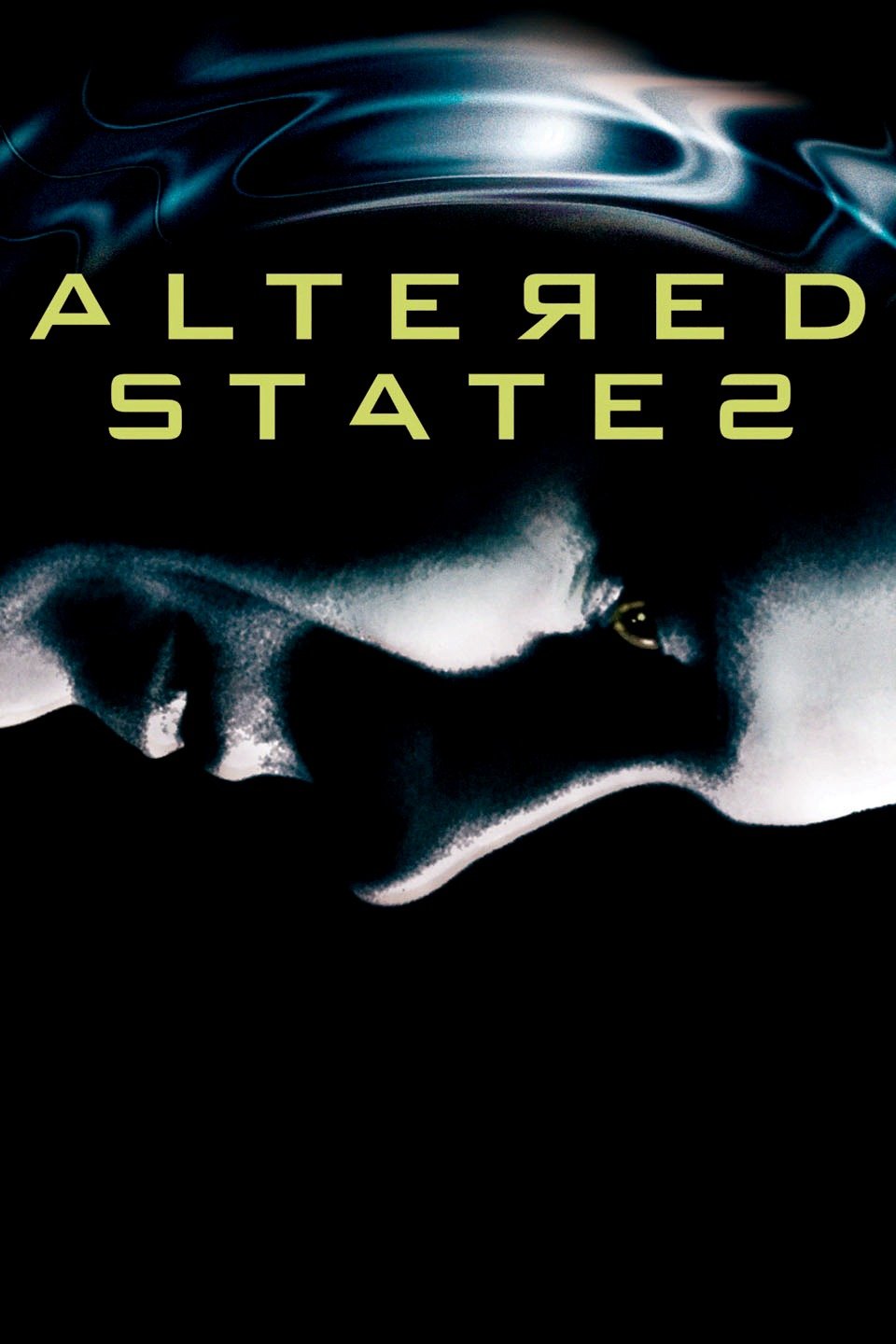
Running time: The film is 1h 42 min (IMDb)
Director: Ken Russell (IMDb)
Release date: 25 December 1980 (IMDb)
Screenwriter: Paddy Chayefsky (IMDb)
Lead actors:William Hurt, Blair Brown, Bob Balaban (IMDb)
 Summary: Altered States takes place in the United States in the late 1960s. William Hurt plays Edward Jessup, a scientist and psychology professor who conducts experiments by using sensory deprivation tanks and drugs made from mushrooms that cause hallucinations. He believes that these experiments will allow him to discover how one can experience different states of consciousness. As he continues experimenting, mostly on himself, he experiences a multitude of altered mental and physical states, slowly driving him further from our shared normal reality. The experiment goes way beyond what Jessup imagined and explores the possible meaning of life and the possible truths about us, humans.
Film techniques:
- Framing:
A medium shot was used on Edward and Arthur when they were walking on the street after coming out of a building in the beginning of the film. This technique allows for “more details [to be] shown than in a long shot while a medium shot can reveal more of the surrounding than a close up” (11). This shot allowed the viewers to see how many people are in their surrounding as they are walking and what is going on as they are walking. This is not an effective technique in this scene because it does not allow us to really grasp a good understanding of where they are. It kind of felt like they were trying to rush on through to the next scene without taking the time to appreciate all of the beautiful scenery that New York has to offer. You only really grasp where they are when Edward takes a walk with Emily in front of Columbia University, which we felt was unconventional in comparison with other movies that states the location right at the start of the film.
- Angles:
A low-angle shot was used in the scene just before Edward gets his hand cut by one of the Indians for the ritual. This technique is generally used to make character look more superior, “larger and more powerful” (11). In the case of this scene, a low-angle shot was used to really show the exclusivity of this gathering around a mystical boiling pot, which was an effective technique. Emphasizing that these very wise men are also powerful because of all their knowledge about this very unique psychedelic mushroom in this very bazar land.
Eye-level shot is presented in the scene of when Edward sees the lizard as Emily after drinking the bowl that had a mix of his blood in that was prepared by the Indians. Eye- level shot is when the “audience sees and object straight on, in which the angle is even with the character or object” (11). He looks at her at an eye-level, which shows a lot of emotions going through him, which makes this shot effective. He looks at her with lust and love.
- Editing:
Short takes where used in the scene when Emily expresses her feelings to Edward about wanting to marry him. As she talks about how she cannot live without him, the single shots lasted “under a second” and it was switching from Emily to Edward (13). This technique “creates a much more rapid, energetic style and pace”(13). Furthermore, it allows us to see “what is important” (13). This technique was effective because it shows what each are feeling during the conversation about marriage. As the camera changes in focus from Edward to Emily, and vice-versa, we get to see the expression of both.
Point-of-view editing is seen when Arthur is looking at Edward putting his child in the crib, and then, we see his face. This technique allows us to see through Arthur’s eyes, which “allows an editor to put us into that character’s shoes” and we become to feel like the character or we think we are that person (13). When Arthur looked at Edward putting the child in the crib as he approached him, the camera switched to showing that Arthur’s face that held a shocked and a disappointed look. This was an effective technique, because as an audience, we felt like we were Arthur and was thinking of asking the same question as he did to Edward. We wanted to ask him why he is divorcing Emily just like Arthur had asked him.
- Costumes:

- Special effects:
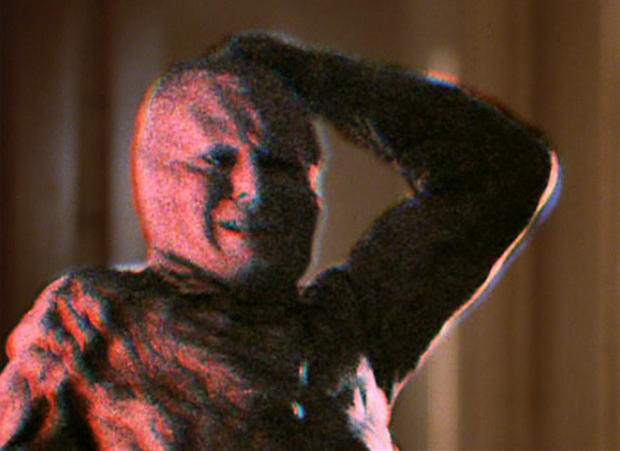
The special effects is an effective technique seen when the lights used during the different altered states and for the energy released from the tank. The lights gave a used impact for the film because they describe the hallucinations and what is going on in the mind during the experiment. For instance, when Edward get in the tank and starts the experiment, he starts hallucinating. During these moments of hallucinations, we see cells looking stuff with different colors, like red, blue, white, or purple. When he is in the Abaddon, the realm of death, the light effect creates something that looks like lava and people are jumping in. Everytime he starts hallucinating, there are flashes of colored lights or images.
Film Themes:
- Consciousness

Edward goes through different states of consciousness. He turns into an ape and a white looking creature. Every time, he enters the tank, he goes into different states of consciousness. According to John Golden, “consciousness is anything that we are aware of at a given moment forms part of our lives” (3). For instance, when Edward gets into the tank and starts hallucinating, he could feel the pain. Not to mention, when he drank the liquid from the bowl that was mixed by the Indians, he hallucinated to the point that he killed a crocodile that he has no recollection of it, but in fact, he did. He also states that in the tank he is “no longer observing”, but “becoming one of them, killing the goat and eating the blood”. He is conscious in the tank and experiences the event as if he would in reality. He states that he entered another consciousness in the tank, and that, there are other states of consciousness as real as “our waking state”. John Golden states “if the creature in question possesses a capacity for consciousness than it can have different states of consciousness”, such as hallucinating when put in the tank (4). Edward states that “hallucination can be externalized”, which can explain the different states of consciousness. Furthermore, the different consciousness cost him his sanity, for instance, he lost his sanity when he transformed into an ape and into the white creature. Moreover, he did not seem to know his boundaries when it came to stop the experiment after it greatly affected his body. For example, when he got pulled out of the tank, he was bleeding from his mouth and nose. He knew the consequences of being in the tank for a long period of time, he still refuses to stop and continues the experiment. At the end of the film, he states that “the final truth of all things is that there is no final truth. Truth is what's transitory. It's human life that is real”. He explains from all the experiment he had done and all the altered state he had experienced made him realize that there is no final truth. Moreover, he means that the truth is short-lived.
- Love
Love seemed like a complicated theme is this film because of how Edward and Emily’s relationship was presented throughout the film. As we all know, love is a powerful emotion, but is it powerful enough to conquer everything in the world? In the beginning of the film, we see that for Edward, it was more lust than love towards Emily, where as Emily truly loved him. She was also the one to bring up marriage. She told him that she wants to be married to him. She was not ready to let him go, when he wanted to back out of their married life. Even after being separated, she still had feelings for him. The pursuit of knowledge led him to lose his family and his sanity. As we saw in the end, when she found out what was going on with Edward after being severely affected by the deprivation tank, she wanted to stop him from continuing the experiment and help him. Her feelings never stopped growing for Edward and it is because of her love she never gave up on him. At the end, love is what saved him from the effect of the tank. Near the end of the film, Edward tells Emily “ I can't tell you how much you mean to me, how much l need you and the kids. You saved me. You redeemed me from the pit”. Edward is pouring out his feelings about how he misses his family and Emily’s love. He knows that she is the only one who could bring him out of his misery. He further states that Emily is the one that keeps the “living horror growing” within him from “devouring” him. Emily pushes him to fight against it and tells him that if he loves her to “defy it”. During the final transformation, the scene ends with Edward saying “I love you” and hugging Emily. Love did win at the end and it is love that led Edward to be transform back into a human from the altered state.
- Meaning of life

The meaning of life is one of the main themes presented in the film. Edward was questioning life and was searching the meaning of life by using the deprivation tank. As he goes through the transition of altered states in the tank, he is experiencing a new life each time. Each states of consciousness give rise to a meaning of life for him and makes him live through different states of consciousness. In the film, he talks about self to Emily when he was drunk. He says “it is the self, the individual mind, that contains immortality and ultimate truth. We know where the self is, in our minds”. He is linking self to consciousness. Not to mention, he further states in the film that he is a “man in search of his true self” and that “everybody’s looking or their true selves” to understand, “get in touch”, “explore”, and to “face the reality of ourselves”. This gives an idea of the need for humans to find themselves in their world to truly exist in reality and to find meaning of their existence in the world. In addition, this explains that Edward is looking for the meaning of his existence. Moreover, he explains to Emily after being released from prison that when he turned into an ape, trying to survive and live at night, that it was his most satisfying part of his life. This explains that he liked his experience of being in a different state of life. Near the end of the film, he further explains to Emily about his experience of when he was turning into a white creature. He says that he “was in that ultimate moment of terror that is the beginning of life. It is nothing”. He states that“ it’s human life that is real”, which explains that life is what we are presently consciously living in. He does prove that an alter states is a type of life to, since we see that he is experiencing different states from being in the tank. He lived few moment as an ape and he turned into a white creature, which were part of his life. However, he explained that those were not a good experience of life at the end, but were simple torture, and that a human life is more real.
(Words 2151)
Film review
One may try to watch this movie as a distraction or a form of entertainment. Indeed, some films are made to distract individuals for their own pleasure but Altered State is not one of them. This movie was made to explore certain philosophical concepts and make one think about our physical world while watching it. This is why one of its main weaknesses is the fact that you are not entertained.
First of all, the movie projects many scenes of nonsense which may make one feel like watching chaos. The excessive use of special effects and visual metaphors, for example, his first hallucination with the native tribe, creates a feeling of being lost and not understanding everything. To really think further, one may have to put the movie on pause at every different scene which is extremely irritating.
Moreover, time moves too fast in this movie. The skipping of years makes one feel like missing certain elements of their lives because we did not get to see the characters during those years that were skipped. In order to know a character, one needs to accompany him or her during the years that influence their personalities. Nobody stays the same throughout life and therefore, when the movie skips from their young adult selves to their old adult selves, we feel like we do not know the characters anymore. They have different lives, they are more accomplished and they do not love each other in the same way. For example, Emily wants to go to Africa and Edward is going to Mexico, therefore they decide to take a break. Moreover, Edward has other intimate relations with other women as if it was normal to do so while being committed to someone else. Their love is totally different from the two young adults sharing a common passion as we saw in the beginning of the movie.
On the other hand, this movie is not all bad. The idea of the self only being a sum of our states in evolution is an interesting concept that was original and refreshing. We all wonder if our dreams are true or if some primary instincts or desires are still buried somewhere in ourselves. This movie offers an interesting answer to those questions: we are in a constant state of evolution and we possess all the states of evolution that we have been in the past.
In addition, one may be interested in the complexity of the characters. Indeed, the main character is not simply a researcher that finds something; it runs far deeper. He is an individual who is stuck between his life work and his loved ones. His passion for his research turns into total madness and makes him so deranged that he inflicts painful experiments to himself and destroys his personal relationships. He loves his research more than his own family and even more than his own self. It is interesting to see a character having such imperfect and complex tendencies.
To conclude, people should run from this movie if they are looking for pure entertainment. However, this movie is a perfect subject for a university thesis or scholar material where you explore the complexity of the self and of the true universe.
To conclude, people should run from this movie if they are looking for pure entertainment. However, this movie is a perfect subject for a university thesis or a school subject where you explore the complexity of the self or of the true universe.
Movie rating: ★★
Class connections
1) Epistemological questions form the core of this film. Every moment of the film raises the question of what do we know about the world around us and how do we know what we know. Jessup is doing something novel in the sense that he is using his own subjective altered states of consciousness as his epistemological method. He creates his method by collecting data through experiments to gain evidence, and discover the truth. The truth of our existence is what Jessup is trying to figure out. He is trying to see what we truly are inside, and how to prove this. Jessup is trying to see what we can know, and what the limits of our knowledge are. This is a question that has been asked for centuries. We have discussed epistemology many times in class, and this movie is just another example of trying to see how much more we can know about the world around us.
2) Metaphysics is also a major theme of this film.What really are we? This film is all about exploring this concept. While in his hallucinations, Jessup is able to go back and see the evolution of life. This leads to the question of what makes us humans. What separates us from apes, protohumans and just atoms. Eddie believes to discover the world of evolution and change, that leaves us with the belief that we are no different. Humans are created from a series of evolutions and changes, and there is no real variation between us and our “past selves”. Humans are just a part of a cycle of evolution. This is a major revolution discovered by Jessup. What he discovers through his experiments questions everything we thought we were as humans.
1) Epistemological questions form the core of this film. Every moment of the film raises the question of what do we know about the world around us and how do we know what we know. Jessup is doing something novel in the sense that he is using his own subjective altered states of consciousness as his epistemological method. He creates his method by collecting data through experiments to gain evidence, and discover the truth. The truth of our existence is what Jessup is trying to figure out. He is trying to see what we truly are inside, and how to prove this. Jessup is trying to see what we can know, and what the limits of our knowledge are. This is a question that has been asked for centuries. We have discussed epistemology many times in class, and this movie is just another example of trying to see how much more we can know about the world around us.
2) Metaphysics is also a major theme of this film.What really are we? This film is all about exploring this concept. While in his hallucinations, Jessup is able to go back and see the evolution of life. This leads to the question of what makes us humans. What separates us from apes, protohumans and just atoms. Eddie believes to discover the world of evolution and change, that leaves us with the belief that we are no different. Humans are created from a series of evolutions and changes, and there is no real variation between us and our “past selves”. Humans are just a part of a cycle of evolution. This is a major revolution discovered by Jessup. What he discovers through his experiments questions everything we thought we were as humans.
3) Another topic brought up is with axiology. We can see that Eddie’s experiments are very dangerous, and can perhaps lead to long term genetic damage. This brings the question is it ethical to performing these experiments. In the end of the film they had mentioned looking for student subjects to perform the same test. Even if they explain that they will take hallucinogens then enter a tank, is it ethical to put them into that situation? The consequences of this experiment went beyond what they expected, so is it ethical to put other people through this? Also, even if it is Jessup’s choice, should he really be doing this? The full extent of these experiments is not known, and with genetic damage, it could also be passed onto future generations. If he were to continue, it is also possible for it to end fatally. This would have a large impact and Emily and his children. This also makes us wonder how far humanity should go in the name of science. There is so much more that could be discovered but we do not consider the experiments to be ethical. This is a big question that humanity faces, how far should we go to discover the truth?
Questions:
- Sensory deprivation tanks are becoming more and more popular with increased accessibility. These tanks are said to produce a wide variety of results in different people. Many people even experience hallucinations. Would you try one?
- In this film we see Jessup go to any lengths to discover the truth, even if it means putting himself and potentially others in dangers. Do you believe that ignorance is better, or is it worth it to make these sacrifices to discover the truth?
- In the last scene of the film, the true meaning is undetermined. Was it an effect of the drug or was he really transforming this far back? What do you think really happened in the last scene of the film?
Web-links
 1) Natural History Museum Website (http://www.nhm.ac.uk/discover.html) As said before, this movie is mostly focused on the big metaphysical question of what makes us human. The best method we, as human, use to know ourselves better is by studying our past and knowing where we come from. This website explores many aspects of our identity like what traits we share with animals that resemble us or what phenomenons happened over time to make us what we are today. Through videos, texts, images and virtual expositions, this website is interesting when it comes to studying our human identity and the life cycle that we have been a part of which is closely related to questions raised in the movie Altered States. (especially this page of the website: “How we became Human” ).
2) Video on Cartesian Skepticism
 (René DesCartes) (https://www.youtube.com/watch?v=MLKrmw906TM) CrashCourse, animated by John Green, is a channel on Youtube that explains many historical events, introduces known individuals and describes different concepts. In the movie Altered States, one theme the movie explores is true knowledge. Edward Jessup discovers that all he knew before was not true. Therefore, he tries to explore the truth about the world, about our true nature as humans. He discovers that everything he knew was not right. He experiences cartesian skepticism which is a concept developed by a ancient philosopher named René Descartes. This specific video explains Descartes’ theory of cartesian skepticism which is basically the action of doubting everything. This theory is directly linked with the research Edward is conducting because both of them are trying to determine the universal truth; what we can be certain of.
Works Cited
“Altered States.” IMDb, IMDb.com, 25 Dec. 1980, www.imdb.com/title/tt0080360/.
Golden, John. “Introducing Cinematic and Theatrical Elements in Film.”
“Altered States.” IMDb, IMDb.com, 25 Dec. 1980, www.imdb.com/title/tt0080360/.
Golden, John. “Introducing Cinematic and Theatrical Elements in Film.”
TeachWithMovies, pp.9-17.
CrashCourse. “Cartesian Skepticism - Neo, Meet Rene: Crash Course Philosophy #5.”
Online
Urry, David & Hendry, Lisa. “How we became human”. Natural History Museum.
17 February 2016.
Russell, Ken, director. Altered States. Warner Bros., 1980.
Video Clip. YouTube. YouTube, 7 March 2016.

Sensory deprivation tanks are becoming more and more popular with increased accessibility. These tanks are said to produce a wide variety of results in different people. Many people even experience hallucinations. Would you try one?
ReplyDeleteTo Answer your question, no I would not try a sensory deprivation tank. I feel like the movie portrayed these tanks as mysterious and frightening. I am not curious to know what would happen as I would not enjoy being in a small space with no sensory inputs. I feel like I would honestly be thinking more about how there are no senses coming to me, then the therapeutic effect of not thinking - what the tank is really trying to do. I think the popularity is from people becoming ore curious with the tanks, but I feel like you must do a lot of research about them before trying them. I don't think I would ever consider trying it!
- Eryka
I found your blog very interesting! It really captured the strangeness of Altered States. One of the main themes your brought up is consciousness. It is interesting how the director ties the main character’s change of physical state with that of consciousness. The deprivation tank’s goal is to remove all of its user’s senses. This movie plays on that idea and dives deeper by making Edward go down the chain of evolution. This connects very well panpsychism which is the theory that everything is made of conscious particles. In this case, the deprivation of one’s sense would alter the composition of the conscious particles changing his state.
ReplyDelete-Justin
Despite the fact that I have not watched this film, I really enjoyed this film blog and thought it was very well made. The summary of the film was well written and helped me to understand the basics of what happened in this film. I especially enjoyed reading the review of the film as it did a great job of not only taking into consideration its strengths in terms of philosophical issues but it also talked about its entertainment value.I think this is a very important aspect of a film review as it is important to let the viewers know whether or not they will be entertained while watching it. Lastly, the links that the group connected this movie was very good. I found it very interesting that the group included a link to the natural history museum website in order to connect it to the question of what makes us human.
ReplyDeleteI really enjoyed reading this blog, I found that it was very descriptive and in depth. Very clean, well structured blog, with great pictures and includes a great summary, that is clear short and not confusing. I really enjoyed reading about the theme of consciousness in relation to Altered States. I liked integration of the quote that you guys used by John Golden, “consciousness is anything that we are aware of at a given moment forms part of our lives” and then listing events that occured in the film for example when Edward kills a crocodile, but has no recollection of it. The director does a good job of relating the change of physical state with consciousness, for example with the incident involving the crocodile which I listed above. Finally i really enjoyed reading your three question as it made me really think and analyze, for example the first question where it really made me think, would i try a sensory deprivation tank. All in all this is my first time reading a blog, and won't be the last time, since I sincerely enjoyed you’re guys is blog and it shows that a lot of time, effort and sweat was put into this masterpiece of a blog!
ReplyDelete-Zachary McCusker